Bugnes. Bugnes are a doughnut-like pastry sprinkled with icing sugar that hail from Lyon. A tradition that I never forget. making bugnes! I have loved them since I was a kid.
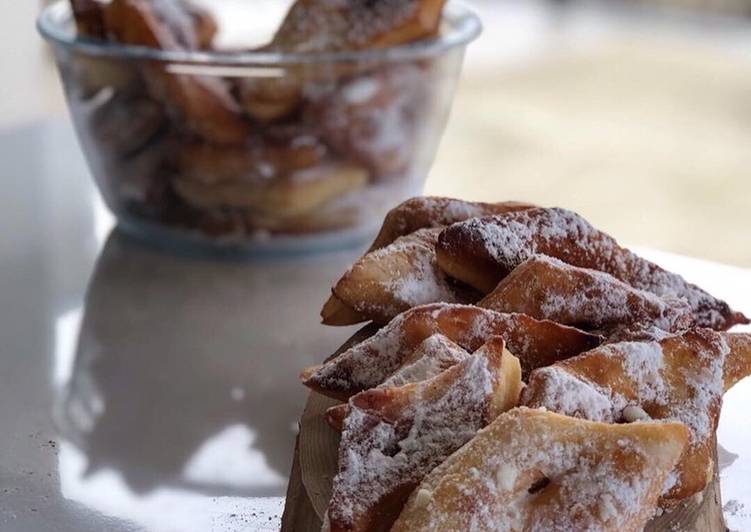 Bugnes are originally a culinary specialty of the Duchy of Savoie, which eventually extended to the center of France (found mainly in the area including Lyon, Rhône valley, Saint-Etienne and Franche-Comté).
French bugnes varieties include crunchy bugnes and soft bugnes.
The crunchy variety, known as bugnes lyonnaises ("Lyon bugnes"), are cooked in very hot oil with the dough spread out thinly and knotted once or twice.
Vous pouvez cuisiner Bugnes using 9 ingrédients et 3 pas. Voici comment cuisiner ça.
Bugnes are originally a culinary specialty of the Duchy of Savoie, which eventually extended to the center of France (found mainly in the area including Lyon, Rhône valley, Saint-Etienne and Franche-Comté).
French bugnes varieties include crunchy bugnes and soft bugnes.
The crunchy variety, known as bugnes lyonnaises ("Lyon bugnes"), are cooked in very hot oil with the dough spread out thinly and knotted once or twice.
Vous pouvez cuisiner Bugnes using 9 ingrédients et 3 pas. Voici comment cuisiner ça.
Ingrédients de Bugnes
- C'est 500 g de farine T45.
- Vous avez besoin 8 g de sel.
- Vous avez besoin 30 g de sucre.
- Vous avez besoin 3 de œufs.
- Préparez 100 g de beurre ramolli.
- C'est de Zeste de citron.
- C'est 1 cuillère à soupe de Rome.
- Préparez 60 ml de lait tiède.
- Préparez 1 de sachet de levure boulangère.
The soft variety, sometimes known as "pillows", are made with a thicker dough, which is rarely knotted. You can find carnival fried doughs with so many different shapes, textures and names in France: the crisp "Bugnes" or "Oreillettes" from the city of Lyon, the "Ganses" from the city of Nice, "Shenkeles" from the Alsace region, the "Nuns Farts" from Brittany… and finally the most famous ones - the classic French Bakery. The dough just gets better as you let it sit in the fridge. Because it makes so much, you can just pull out what you want to cook, punch the rest down and put it back in the fridge.
Bugnes instructions
- Dans le lait tiède verser la levure et laisser 15 minute. Dans le bol du pétrin, versez la farine, le sel, le sucre, le rhum, la levure avec le lait, les œufs et le zeste de citron. Lancer le pétrissage au crochet (au à la main) pendant 15 min environ. La pâte doit se détacher des parois du bol. Ajouter alors le beurre ramolli en plusieurs fois tout en continuant de pétrir. La pâte devient souple et élastique et se décolle du bol. Laisser reposer 2h.
- Après ce laps de temps, étalez la pâte au rouleau sur 5 mm d’épaisseur pour moi. Vous pouvez faire plus fin. Avec une roulette, découper des losanges, carrés, rectangles de la taille qui vous plaira.Faire une incision au centre de chaque bugne. Laissez de côté et continuez jusqu’à épuisement de la pâte..
- Faire chauffer l’huile de friture. Lorsque qu’elle frémit et pas brûlante, plongez y les bugnes. Dès qu’elles sont dorées, retirez les et laissez égoutter sur du papier absorbant. Laissez refroidir et les poudrer de sucre glace.
The dough is cut in strips, then deep fried and sprinkled with sugar. The word Bugnes is a Provencal adaptation of the French word beignet meaning fritter. The Bugnes originated from Ancient Rome, and were prepared during the carnival. Bugnes are a doughnut-like pastry sprinkled with icing sugar which hail from Lyon. A tradition that I never forget. making Bugnes!